
Articles

Four articles, 2020 to 2023

Each entry gives the citation, a summary written for a general legal reader, and the publisher's page. The 2020 article is open access; the other three are behind the publishers' paywalls.

International Criminal Law and Customary Law for Punishment of the Perpetrators of International Crimes in South Sudan

Kuel Jok, 'International Criminal Law and Customary Law for Punishment of the Perpetrators of International Crimes in South Sudan' (2023) 61 International Annals of Criminology 265. Cambridge University Press.

The African Union Commission of Inquiry accused both the Government of South Sudan and the rebels of crimes against humanity and violations of international humanitarian law in the war that began in December 2013. Three responses have competed since: an Africa-led tribunal recommended by the African Union, the hybrid court written into the peace agreement, and the government's preference for amnesty.

The article argues that amnesty threatens peace because customary law rejects it, leaving clans to pursue vengeance on their own. It proposes a hybrid tribunal that applies the principle of complementarity alongside customary blood compensation, apok or cot, with fixed prison terms in place of life imprisonment or the death penalty.

Violation of the Constitutional Law and International Provisions in the Dismissal of Justices and Judges from South Sudan Judicial Pillar

Kuel Jok, 'Violation of the Constitutional Law and International Provisions in the Dismissal of Justices and Judges from South Sudan Judicial Pillar' (2023) 31 African Journal of International and Comparative Law 1. Edinburgh University Press.

The President of South Sudan dismissed 14 justices and judges by decree. The President and the Chief Justice held that the dismissal complied with the Constitution; the judges argued that it violated both the Constitution and the East African Community Treaty. Rather than seek a remedy in the Supreme Court, they sued in the East African Court of Justice.

The article finds three reasons for that choice: constitutional immunities shielding the executive from lawsuits, section 33(2) of the Civil Procedure Code 2007, which lets the Minister of Justice stay a lawsuit, and impunity within the executive. It recommends that voters press the legislature to amend the Constitution and repeal the immunities and section 33(2), since the power to stay a case frustrates the independence of the judiciary.

The Right of the Amputees in the Sharia Courts of Sudan under International Law

Kuel Maluil Jok, 'The Right of the Amputees in the Sharia Courts of Sudan under International Law' (2022) 26 Journal of Disability & Religion 46. Published online June 2021. Taylor & Francis.

Between 1983 and 2019, Sudanese criminal courts applying Sharia sentenced people to cross-limb amputation under Article 168(b) of the Criminal Act. The article asks how those amputated, now unable to work, can be assisted to secure food for their survival within national institutions, and grounds the answer in the obligation international law places on states to protect the right to food of natural persons.

Incompatibility of the Principle of Complementarity and Sharia for the Accountability of the Perpetrators of the International Crimes in Sudan's Darfur

Kuel Maluil Jok, 'Incompatibility of the Principle of Complementarity and Sharia for the Accountability of the Perpetrators of the International Crimes in Sudan's Darfur' (2020) 8 Journal of Law and Criminal Justice 14. American Research Institute for Policy Development. Open access.

After the removal of Omar Al Bashir in April 2019, those charged by the International Criminal Court with genocide, crimes against humanity and war crimes against the Fur, Zaghawa and Masalit peoples of Darfur still faced only domestic charges of money laundering and terrorism. Some in Sudan reject their accountability altogether; others propose trying them in national courts under the principle of complementarity.

The article shows why the second route creates a conflict of laws: Sudan is not a State Party to the Rome Statute, and its Criminal Act of 1991 and constitutional provisions are derived from Sharia. It suggests that Sudan adopt either a monist or a dualist system in its judiciary as the mechanism for holding Al Bashir and the other fugitives to account before the ICC in The Hague.
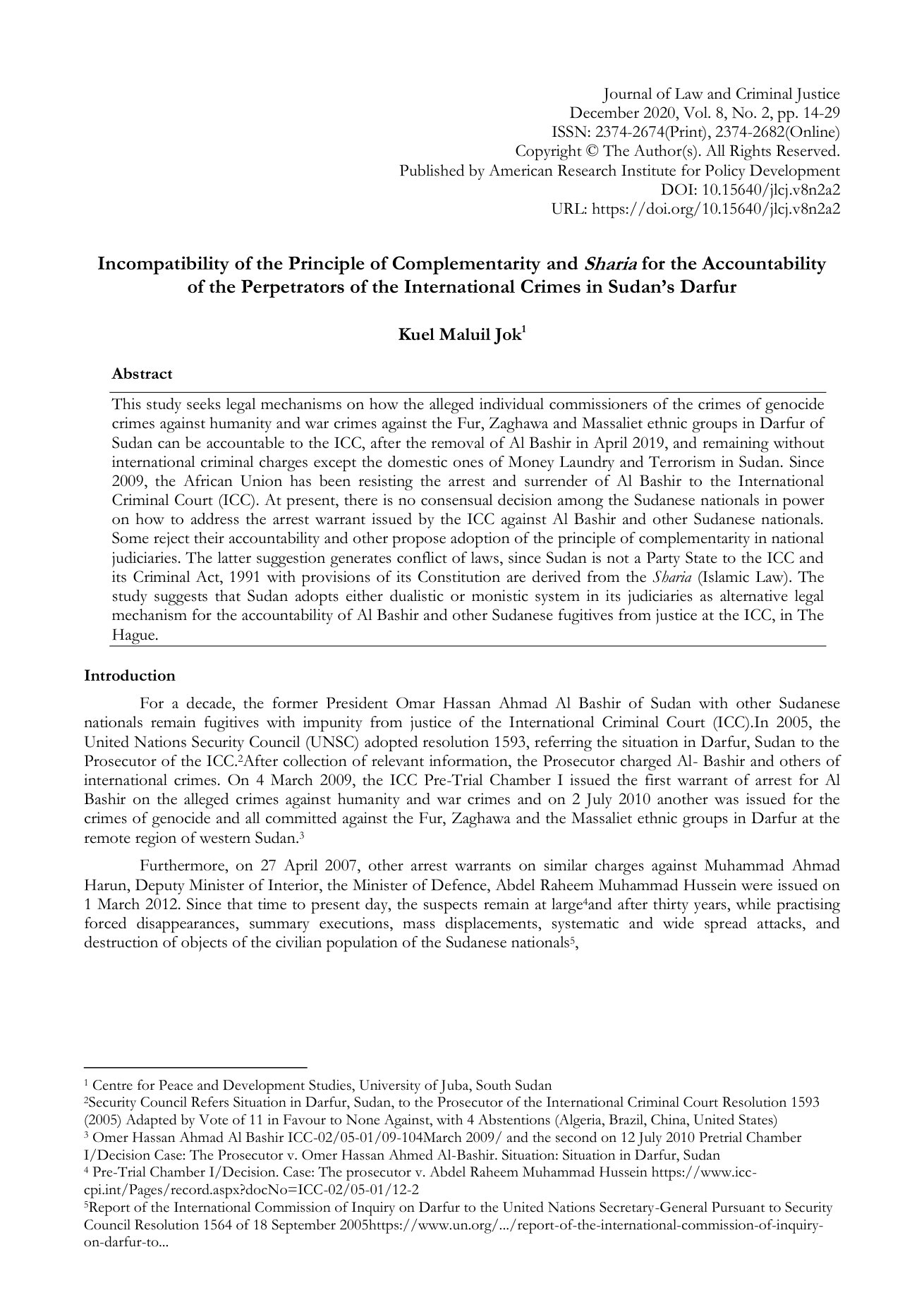

First page of the article as printed in the Journal of Law and Criminal Justice
First page as printed, vol. 8, no. 2, December 2020.
Legal opinions

Need a written opinion on one of these questions?

Prof. Jok writes opinions for courts, counsel and institutions on the law of Sudan and South Sudan. State the question in a sentence or two and who will read the opinion.